Dangerously high levels of the bacterium which causes Legionnaire’s disease were found at Hawes when a comparison study for Stop Ure Pollution (SUP) was carried out on the Rivers Ure, Wye and Thames recently.
Another bacterium found at Hawes was described as a serious pathogen by the UK based biotechnology company, Molendotech, which carried out the comparison arranged by SUP Chairman Richard Loukota. The company analysed water samples from two sites on the River Thames, one on the River Wye and one on the River Ure using environmental DNA (eDNA) testing. Only those from the Ure were described by the company as of the highest clinical concern.
And throughout July 2026 high levels of pollution were found by SUP volunteers at Aysgarth Falls and Ulshaw Bridge (below).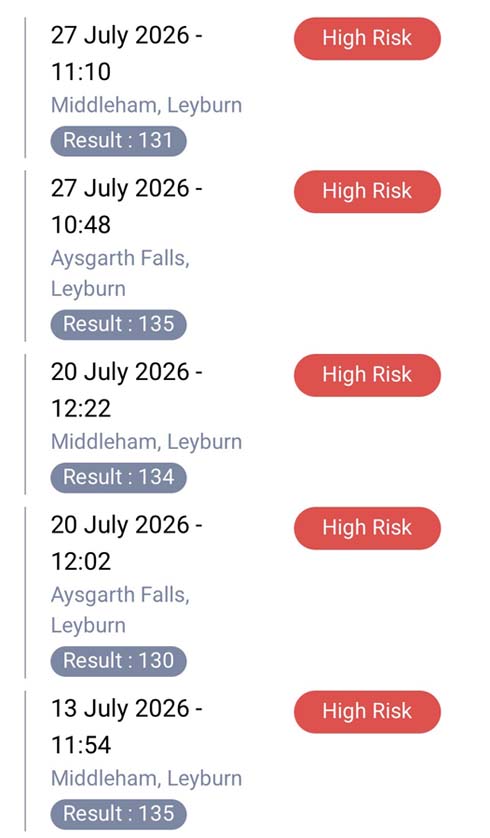
The pollution in the Ure was highlighted last week when SUP received a report from a visitor that his dog, Elsie, became seriously ill after drinking river water.
Elsie’s owners informed SUP: ‘On the weekend 10th-13th July 2026 our German shepherd dog was playing in the water at Wensley (bridge) dipping to collect and chase stones, obviously digested water and was ill all weekend during our holiday and then rushed home because she eventually needed a vet’s visit to try and stop the continuous diarrhoea! The river seems to have serious issues.’ Thankfully, Elsie has recovered.
Richard Loukota, Chairman of Stop Ure Pollution, said: ‘The [test] results should be a wake-up call.
The River Ure has performed worse than the River Wye, which is widely regarded as one of Britain's most environmentally damaged rivers, and worse than the Thames despite its far larger population.
‘It is time for every organisation with direct or indirect responsibility for the river; the Yorkshire Dales National Park Authority, the Environment Agency, Yorkshire Water, farmers, agricultural contractors, landowners and Local Authorities to acknowledge the scale of the problem and work together to stop pollutants entering the river.’
And SUP’s vice chairman Toby Milbank commented: ‘The Environment Agency's "advice-led" approach has run its course and has been largely ineffective in protecting England’s rivers. The Farming Rules for Water must be properly enforced, illegal slurry spreading of organic manures is a criminal offence but the number of prosecutions in the River Wye catchment, Thames and the River Ure Catchment combined, is currently zero. In addition, 1,797 sewage overflow events should never be regarded as acceptable. Only by tackling agricultural runoff, improving sewage treatment infrastructure and restoring natural river buffer zones will we begin to return the River Ure to good ecological health.’
The River Wye has become the national symbol of river decline after years of ecological damage caused primarily by agricultural runoff and sewage pollution. Yet the River Ure sample contained E. coli levels of 3,700 CFU/100mL—almost twice those recorded in the River Wye and more than five times the level found at Henley on the River Thames, despite the Thames serving a vastly larger population.
The River Ure sample also contained elevated levels of Legionella pneumophila and Pseudomonas aeruginosa, together with extremely high enterococci counts, all recognised indicators of significant faecal contamination and poor water quality. The findings reinforce Stop Ure Pollution's weekly monitoring at Aysgarth Falls and Ulshaw Bridge
SUP believes the evidence points towards a combination of diffuse agricultural pollution, particularly slurry and manure entering watercourses, together with untreated sewage released from wastewater treatment works and storm overflows. During the winter, volunteers recorded and reported 192 acres of alleged illegal slurry spreading to the Environment Agency, while Yorkshire Water's 18 sewage treatment works in the River Ure catchment recorded 1,797 sewage overflow events lasting a combined 4,215 hours during 2025, combined, this is a total of over 175 days of untreated sewage entering the River Ure.